Amazon Expedition, Brazil

Exploring the giants of the rainforest

Deep in the Amazon there is a place where, surrounded by the wilderness and all her inhabitants, you can experience the rainforest in an extraordinary way. Travel journalist Marco Barneveld and photographer Frits Meyst went on an expedition.

TEXT: Marco Barneveld

PHOTOGRAPHY: Frits Meyst

Magazine › Dream Now, Explore Later

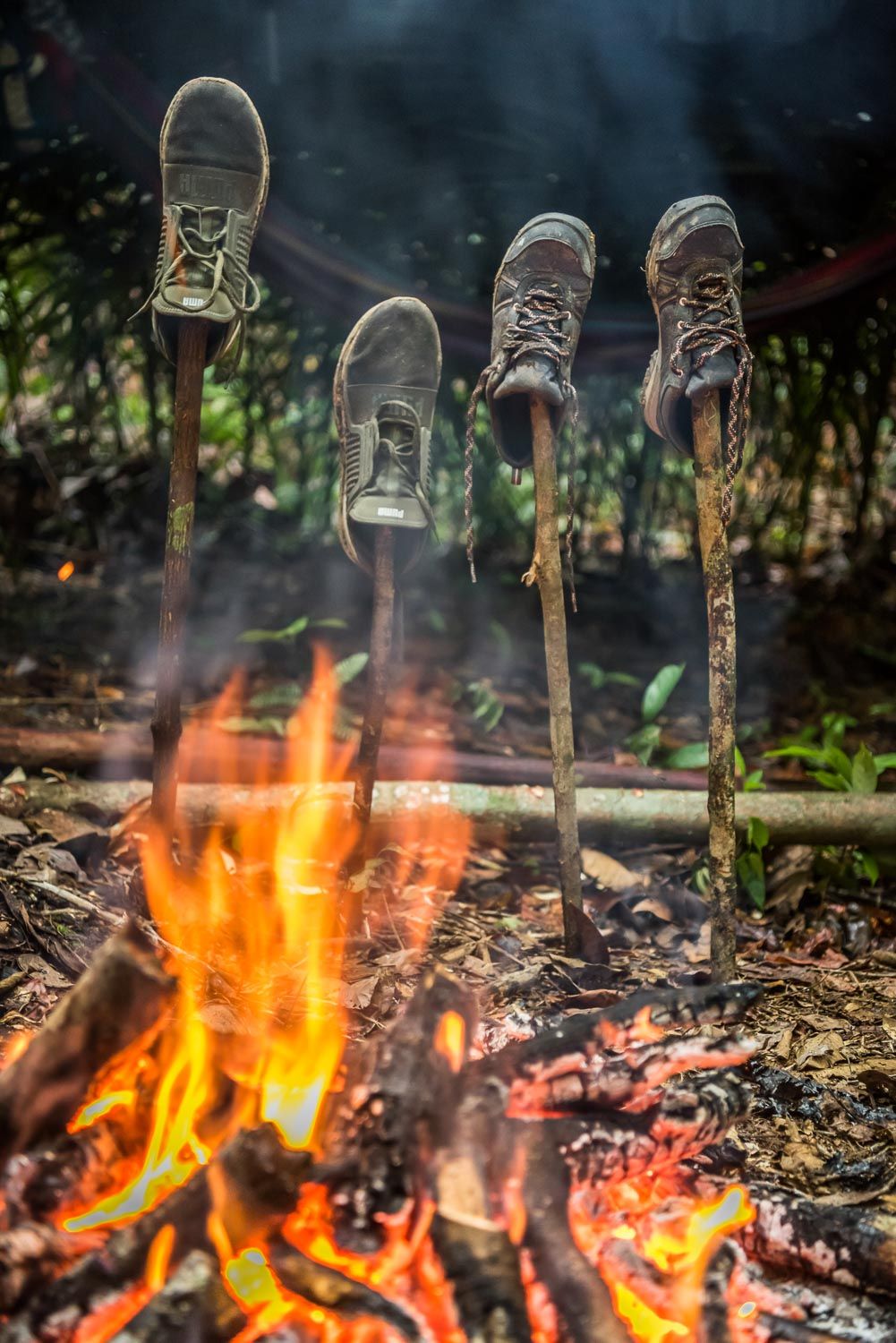
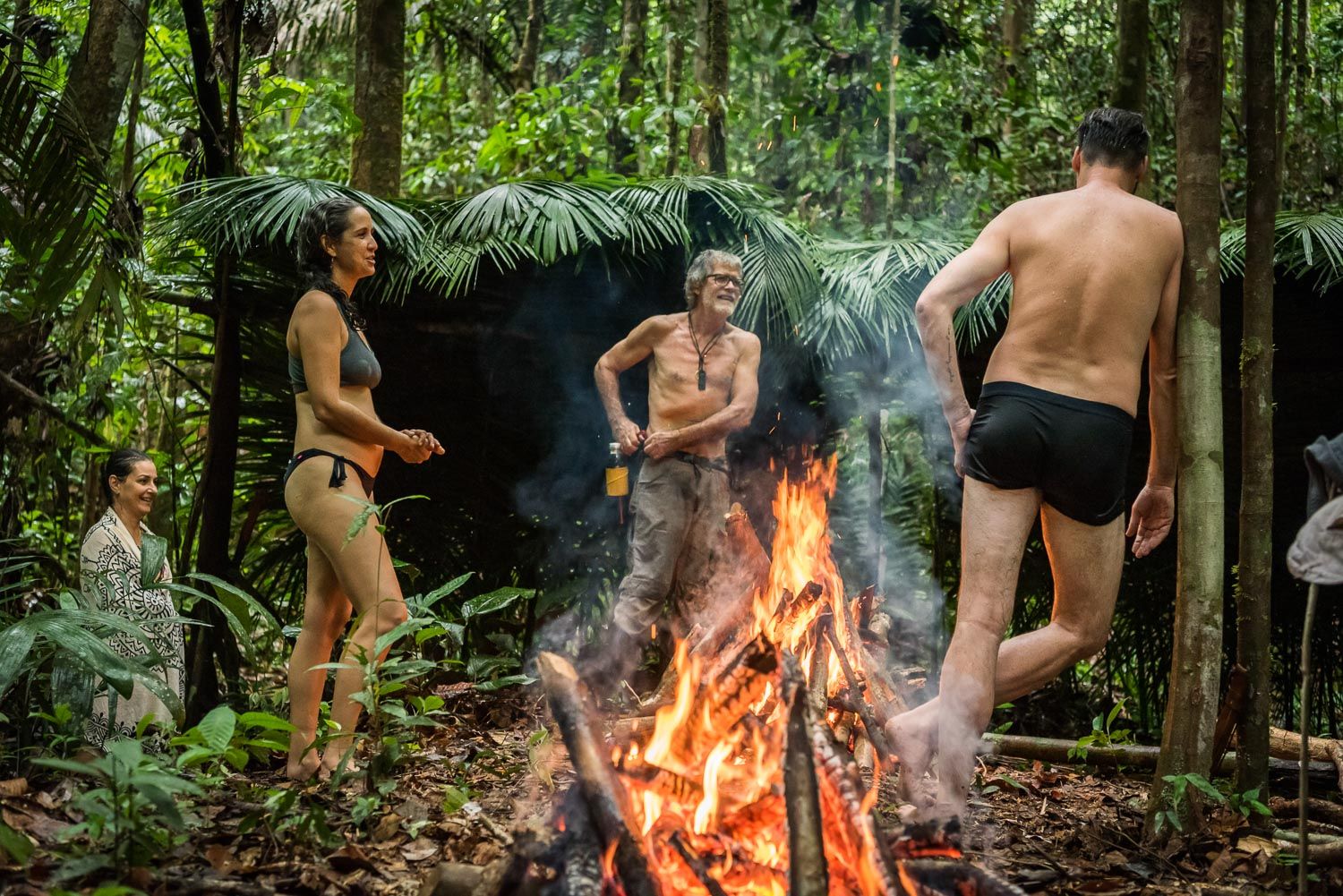
In the flickering light of the dying campfire, the shadow of the sting on top of the scorpion’s tail seems larger than it is. But still. It isn’t small. Drawn by the light and heat of the flames, he scurries, with a body that is around ten centimetres long, through the fallen leaves on the jungle floor below my hammock. The jungle’s nocturnal animals all seem the be having a campfire party. Now, I’m no expert when it comes to spiders, but that hairy, hand-sized thing that came lurching past on eight legs just now, looked a lot like a tarantula to me. Even though those are not dangerous for humans, you do wonder whether his very venomous cousin from the Araneae family, the Brazilian wandering spider – Phoneutria nigriventer – is also lying around somewhere. The spiders are called wanderers, because they crawl the jungle floor at night looking for prey, instead of weaving a web. And it just so happens to be night. In the jungle. Around us, rutting male cicadas cry, whistle, screech, growl and tap at the top of their voices up to more than ninety decibels, to impress the females. The biggest bawler wins. To complete it, throw in a concert of tree frogs on a symphony of rustling and fluttering leaves. Welcome to our night camp in the Brazilian Amazon.

The Amazon is wild, untamed, a living organism in which everything is connected. Here, man is no ruler, just a visitor


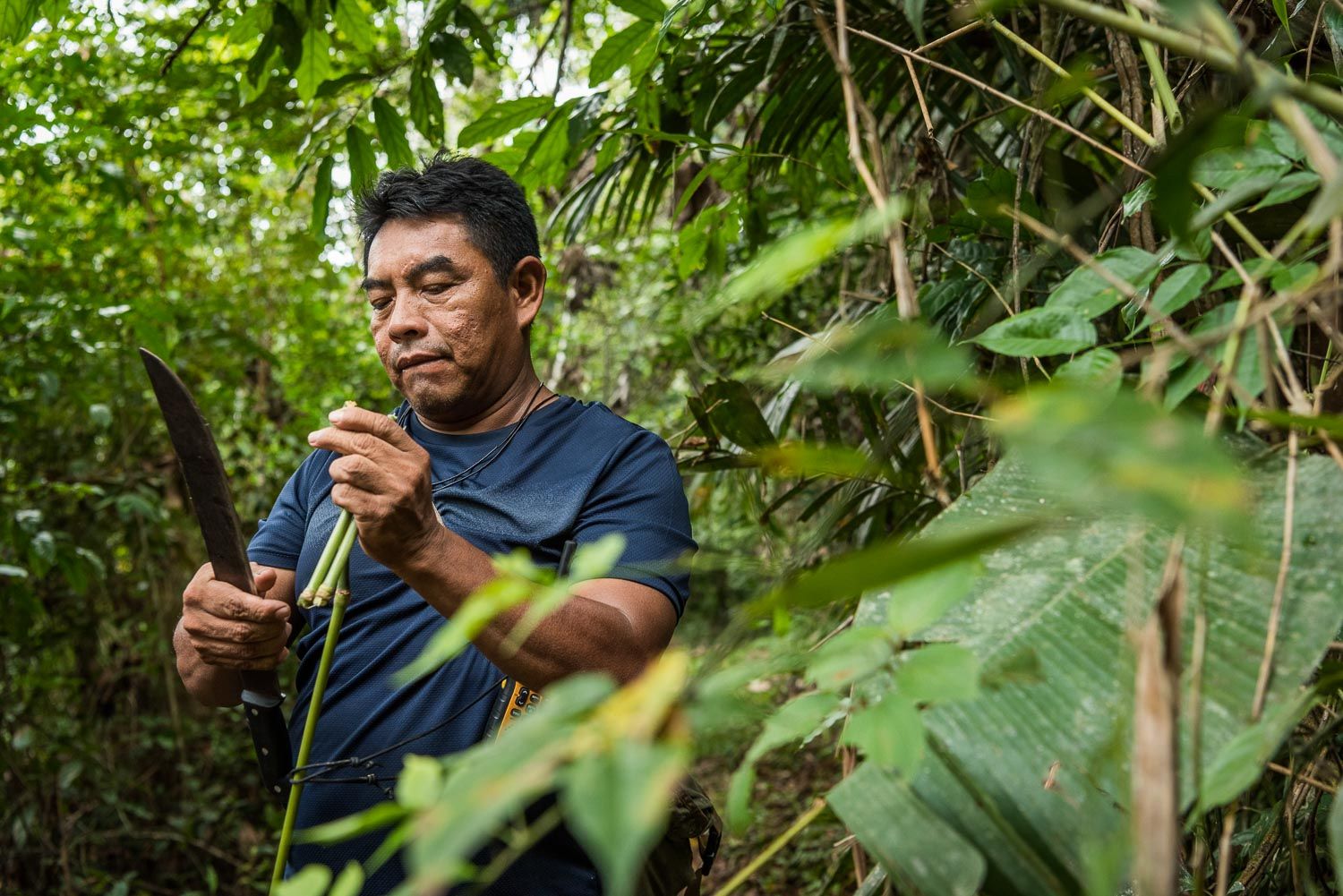
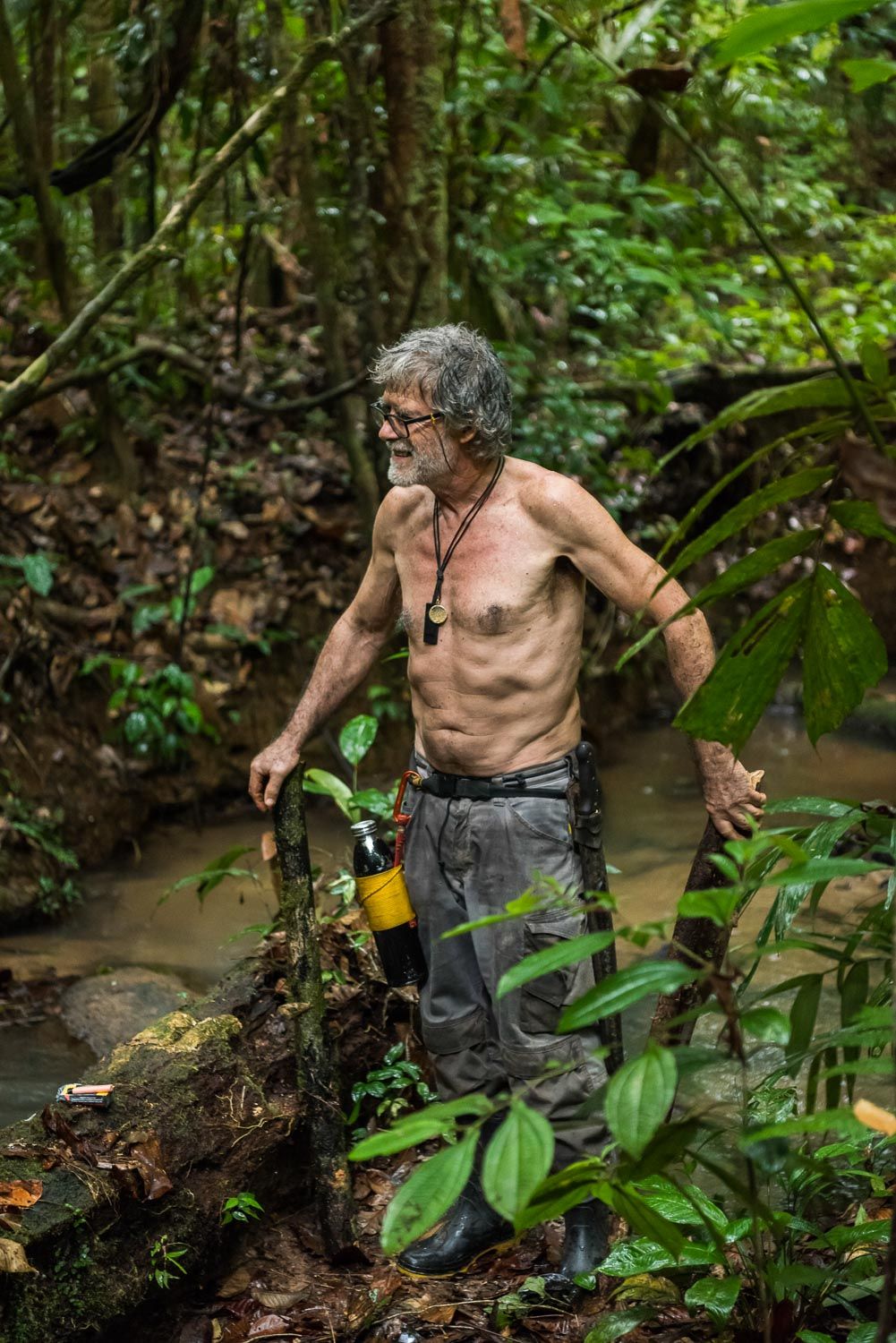
It is exciting, that’s for sure. The Amazon is wild, untamed, a living organism in which everything is connected. Here, man is no ruler, just a visitor. Humility is befitting. Whoever thinks he can just take a hike without expertise, risks life and limb. There are many ways to die in the rainforest. Guide Samuel Basilio knows the jungle better than anybody else. As a scout in the Brazilian army, he was stationed in the middle of this forest uninterrupted for two years. Without a supply of anything. Depending only on whatever available in the wilderness to survive. And surviving is his second nature, as second-generation descendent of two indigenous Indian tribes: the Baré on father’s side and the Baniwa on mother’s side.

Manaus

It seems ages ago that we left Manaus the day before yesterday, the capital of Amazonas, the largest of the 26 Brazilian provinces. In comparison: Amazonas is as large as France, Germany and Spain combined. The Netherlands fits in it almost 37 times. Nevertheless, this area is sparsely populated, only four million people live here, half of which in Manaus. During the Amazon rubber boom from 1879 to 1912, the city became fabulously rich. But when in 1912 the rubber price plummeted, the city fell into decay rapidly.

Manaus seems unreal. An enormous city filled with ghastly buildings, mouldy concrete colossus and here and there a well-preserved pearl from the old glory days. Like the beautiful neo-classicist opera building Teatro Amazonas from 1896. The rubber barons were big spenders when they still had money. And what a location they picked for a city this size: In the middle of the humid jungle, on the shores of the Rio Negro and the Rio Solimões, that fuse into the Amazon River. A spectacle called ‘Encontro das Águas’, Portuguese for ‘meeting of waters’. For six-kilometre, the warm blue-black water of the Rio Negro and the cooler, sand-coloured water of the Rio Silimões stream slowly sideways. If you want to reach Manaus, you can do so by plane or by boat. Forget the road. The roads available are in bad condition, mostly overgrown or washed away. On top of that, the distances are enormous. Rio de Janeiro, for example, is 4300 kilometres away. That’s from the Netherlands halfway to Iraq. Or to the North Pole.


For six kilometres, the warm blue-black water of the Rio Negro and the cooler, sand-coloured water of the Rio Silimões slowly stream side by side

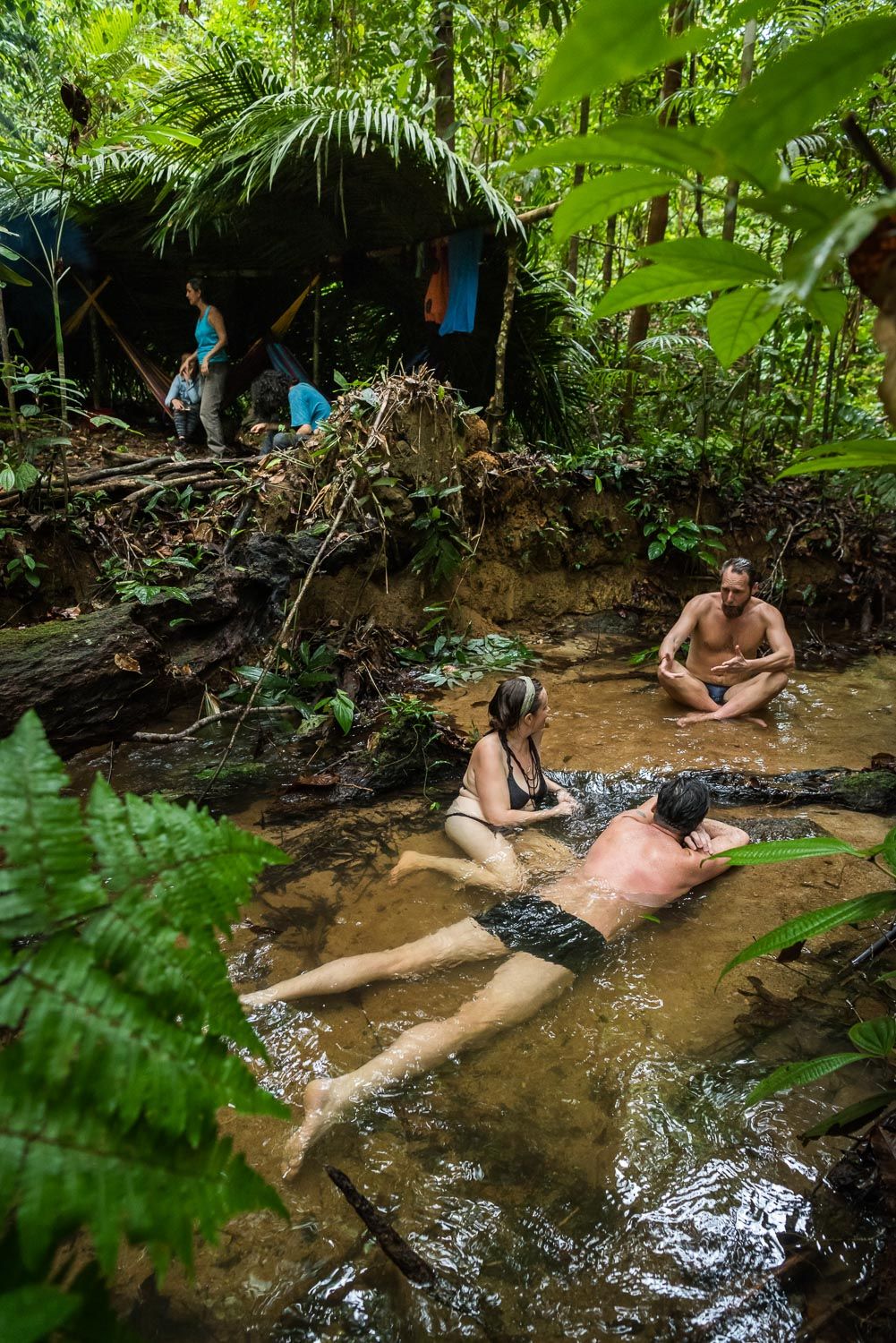
Manaus is our stop-over on our way to the house of Vanessa Marino and her partner Leo Principe, about 120 kilometres north of Manaus, in the municipality Presidente Figueiredo. Originally from Venezuela, Vanessa and the French-Italian nature protector and photographer Leo bought more than 270 hectares here, an area as large as Utrecht’s inner-city area, and built a house for themselves, their three children and Vanessa’s mother. They also built a guest house on the terrain. With their company Amazon Emotions, they welcome guests here on a very small scale, who they then teach about the beauty of the rainforest. The reception here is so welcoming and free, that I instantly feel like a family friend instead of a paying customer.

The earth’s lungs

The house is built on a hill, one of the highest points for miles around. Lying in my hammock on the veranda of the guesthouse, I look out over what is primarily rainforest. In the distance, I hear the howls of howler monkeys and the screeching of parrots. The flowers make the jungle’s roof turn purple in the lingering white mist. Smells of fresh rot, earth, heat and humus find their way into my nose. The smell of fertility. It is almost surreal, this view of the purple coloured tree treasure, this sight of an untouched planet.


Since sixty per cent of the Amazon’s biodiversity is situated in the treetops, Leo developed a non-invasive technique to climb the rainforest’s woodland giants


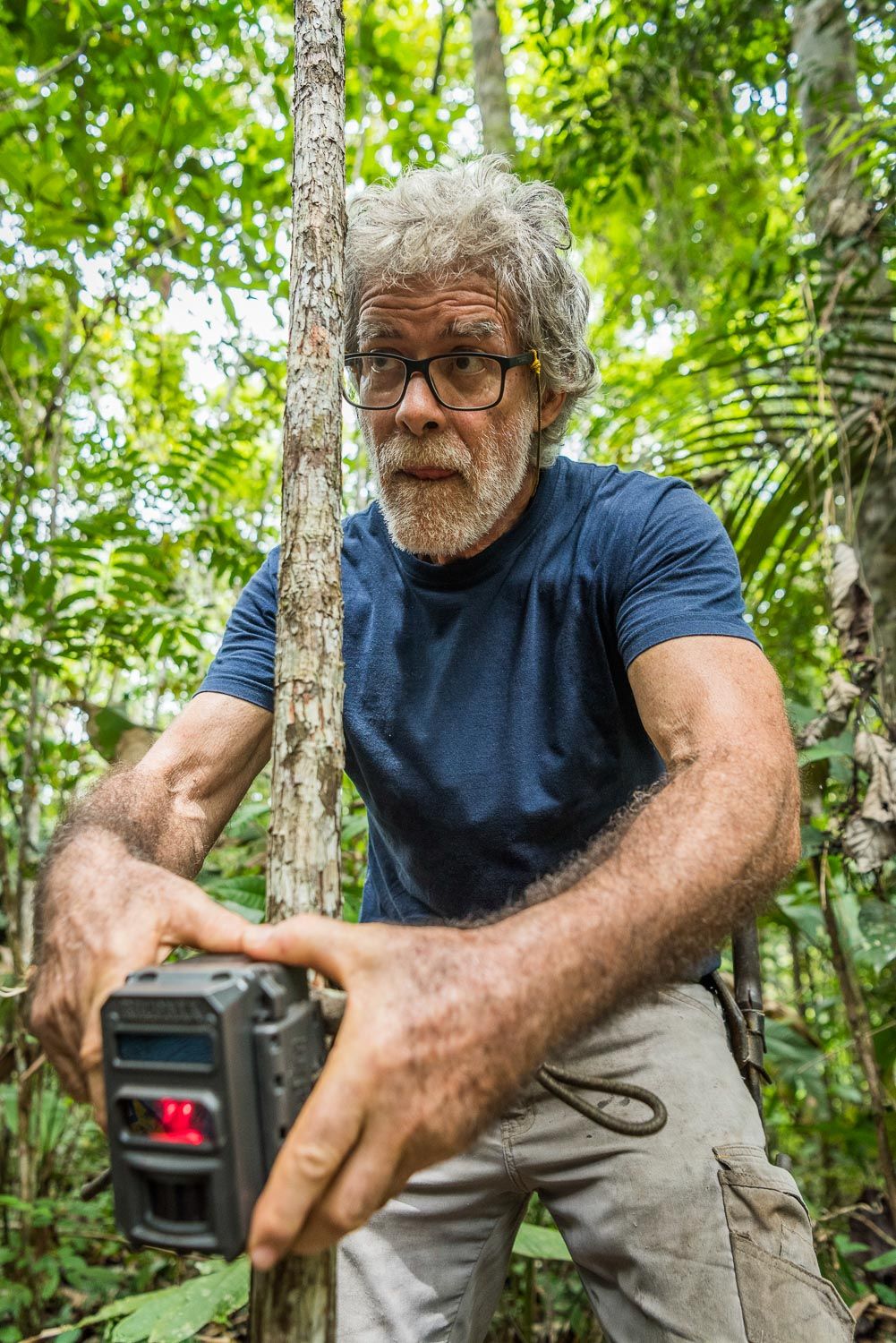
Leo Principe lost his heart to the Amazon, and everything that lives and flourishes in it, about forty years ago. ‘In 1989, I was captain of a luxurious sailing yacht. We sailed over the Amazon for a bit. I was overwhelmed by nature’s beauty and decided to return’, Leo tells me. ‘Four months later, the time was there. I had arranged a meeting with the INPA (Instituto Nacional de Pesquisas da Amazonia, the national Amazon research institute, red.) for a photography assignment on river dolphins in the Amazon. I flew from Barbados to Manaus, looked out of the window and I couldn’t take my eyes of the green sea of trees. I never left.’
In the following decades, Leo documented the Amazon’s flora and fauna. Next to publications in prominent media, like National Geographic, he published a large number of photography books.  Since sixty per cent of the Amazon’s biodiversity is situated in the treetops, Leo developed a non-invasive technique to climb the rainforest’s woodland giants, to be able to photograph the life there as well. His goal: make people aware of the richness of this area, which is called the green lungs of the earth for a good reason. “When I started my relationship with Vanessa in 1998, we travelled through Brazil in a campervan for a year,’ Leo tells me. ‘A journey that led to new initiatives. We wanted to learn more about ecological construction, clean energy, better, more sustainable ways to deal with the jungle, etcetera. For us, nature conservation is a way of life. We have implemented all that knowledge in and around our land and we try to get this across to our guests.’ Leo and Vanessa teach their children Geo (17), Kinan (16) and Kena (11) themselves in formal education and the wonders and rules of the rainforest. On top of that, they get to choose and study online what else they are interested to learn. That seems to work remarkably well. Geo now speaks six languages.
Black earth

Leo is fascinated by agricultural techniques of former civilisations, and mostly by terra preta. ‘Terra preta is a very fertile black soil type that covers ten per cent of the Amazon basin,’ Leo explains on the spot where he tries to reproduce this man-made soil. ‘This soil is extremely fertile and hardly ever gets exhausted. Terra preta was first created 1500 to 2800 years ago. It is created by making charcoal from certain plants around here and mixing it with the soil already there. Terra preta does not just function as a water and nutrient sponge, but the humus soil breaks down slower and colonies of micro-organisms come into being in the soil, guaranteeing a sustained supply of nutrients. Amazing stuff.’


‘This soil is extremely fertile and hardly ever gets exhausted.’


But it’s not only terra preta that fascinates him, he also researches other traces left behind by that same forgotten civilisation. He shows me aerial photographs revealing large circles. ‘We now know what those circles were: huge fishing ponds. I am fairly certain the Indians dug those fishing ponds, because they are clearly man-made. Around the ponds, various types of fruit-baring trees grow, like açai and lupuna. The planted trees were selected in a way that they bear fruit throughout the year. Because the trees were growing on the water’s edge, those fruits fell into the pond. Fish food. All-year-round. Without the Indians having to do anything themselves. Genius, right? I want to make such a pond on our land as well.’

I too put some powder in the straw and blow it into my nose through the other end. A sharp pain shoots through my head and my eyes tear up instantly


Rustling

‘Do you want to try this?’ Leon winks at me and hands me some kind of wooden straw with two ends. ‘This is the powder the Indians used to clean their cavities,’ Leo explains, his eyes sparkle. ‘Wait, I’ll show you.’ He takes a box and opens it. It contains a brown powder. Leo takes a little bit of the stuff between thumb and index finger, puts it in one end of the straw and puts that end to his nose. The other end he puts in his mouth, and then he blows hard. I see his face twitch. Then he hands me the straw. I too put some powder in the straw and blow it into my nose through the other end. A sharp pain shoots through my head and my eyes tear up instantly. Wow. ‘Now blow your nose,’ Leo says. I won’t go into detail, but my head empties forcefully. And then, all smells become three times as intense. ‘You need all your senses sharpened as much as possible in the jungle,’ Leo explains. ‘A stuffy nose can be a handicap. This is a secret recipe to solve that problem.’

I am reminded of Leo’s words when we walk through the rainforest later on, looking for a good spot for our camp. Guide Samuel leads. Here and there, he uses his machete to cut away a plant blocking our path. Suddenly, he stops and signals with his hand for us to do the same. He looks around, almost skittishly. Slowly he puts his nose in the air and inhales the jungle air deeply. ‘Do you smell it?’ he whispers. I, too, inhale the air but don’t get past the moist soil, rotting plants and tropical flowers. Samuel nods in northern direction. Again I put my nose up in the air, but I really don’t know what he is talking about. Samuel looks at me and whispers: ‘Jaguar.’ Immediately, I am alert and look back. This feline predator is known for jumping his prey from behind to shatter the skull with a snap of his powerful jaws. Only yesterday, Samuel told me about one of his family members who was attacked by a hunting jaguar at night.

Samuel nods in northern direction. Again I put my nose up in the air, but I really don’t know what he is talking about. Samuel looks at me and whispers: ‘Jaguar.’

I hear rustling and jump up, but Samuel’s posture shows me our surroundings are all clear. “When my family member disappeared, we didn’t hunt the animal,’ Samuel says. ‘We caught a capybara, a giant rodent, and sacrificed it to the jaguar.’ In the jungle, the jaguar is king. Samuel grabs his machete and cuts off a branch, keeping his finger on the tip. ‘Open your mouth,’ he says, and he pours cool liquid from the branch into my mouth. Delicious. You need to know where to cut,’ Samuel explains. ‘The right spot doesn’t harm the tree, allowing for a new branch to grow within a week, with the same liquid. When you know the jungle, you will never go hungry or thirsty.’ Samuel leads the way, and every now and then he shows us another cool jungle trick: how to make a spear within a minute, or a plant that makes a rope or spears super-fast.

Amazon facts

  • The Amazon rainforest is around 5.5 mln square kilometres in size. That is about 192 times as large as the Netherlands.
  • About twenty per cent of the earth’s oxygen is produced by the trees in the Amazon forest. The Amazon has an enormous impact on climate and global warming. After all, the trees store a huge amount of carbon.
  • In the past fifty years, about twenty per cent of the Amazon forest was cut down.
  • The Amazon forest is home to an incredible amount of life: about 16.000 tree species, 2,5 million types of insects, 40.000 different plants, 430 mammals, 1300 bird species, 380 reptiles, 400 amphibians and 3000 fish. And that’s just what has been discovered, a lot is still unknown.
  • Many organisations dedicate themselves to the preservation of the rainforest. Think of WWF. Small scale eco-tourism is also a way to do your part. This way, the tropical rainforests earn money without people harming the forest or catching endangered animals.
Cheeky monkeys

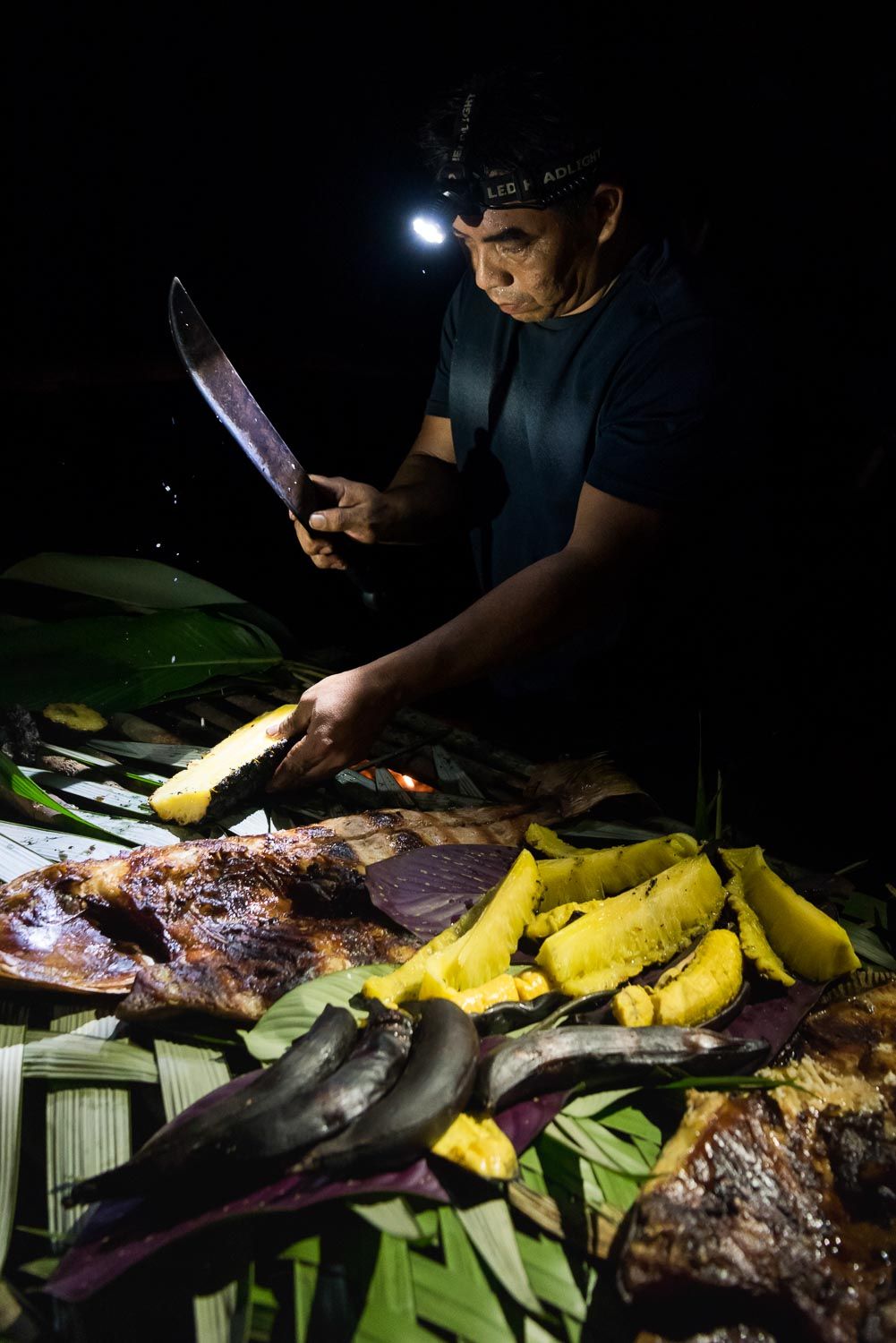
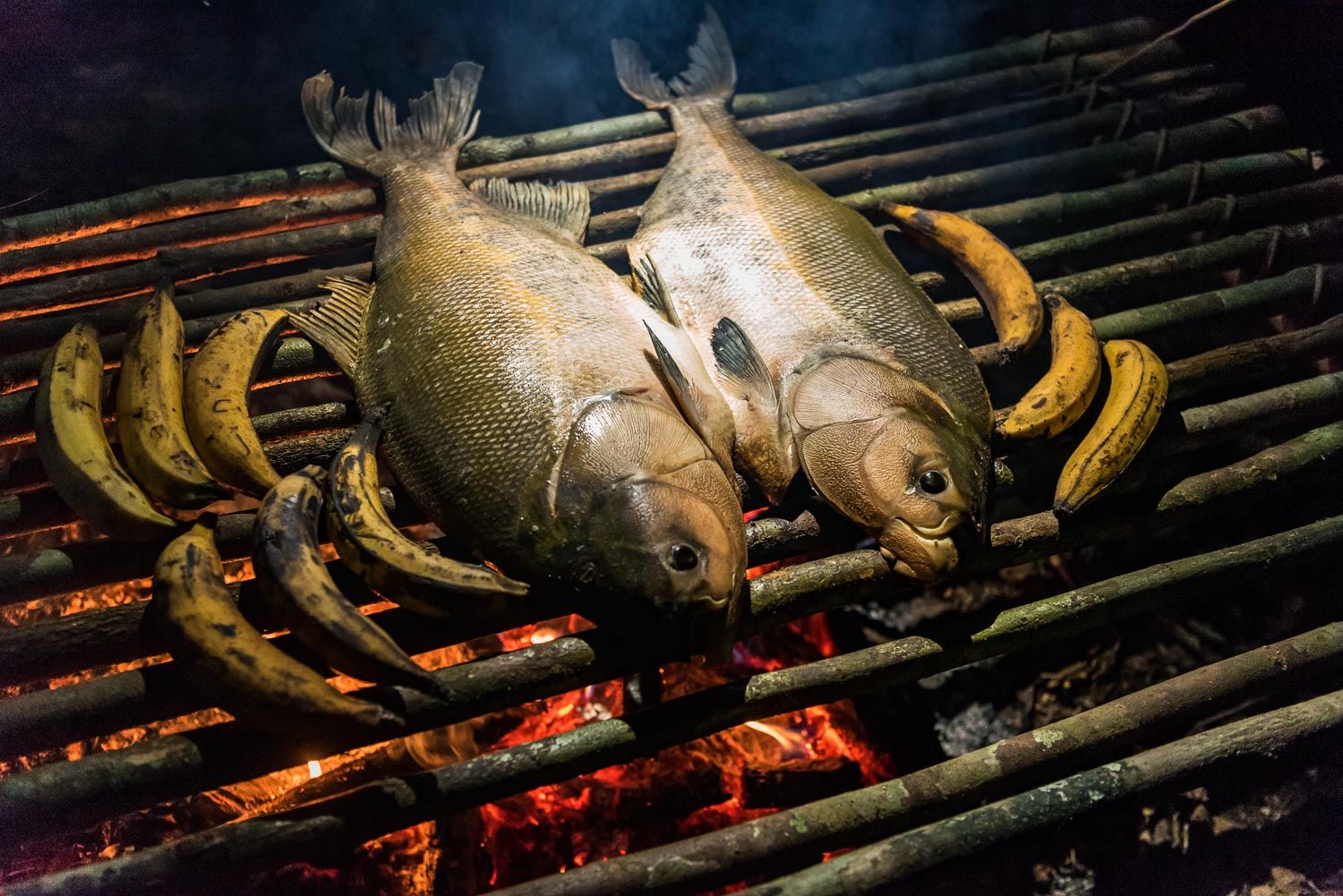
My travel companions are asleep in their hammocks, only Samuel and I are awake. Samuel keeps watch, I am reflecting on the day in my hammock. An hour ago, we roasted and ate two tambaqui. The tambaqui is a really fatty fish, a type that likely lived in the old fishponds. The fish is fat because they feed on nuts and fruits from the trees that grow along the Amazon river. Delicious fish. Samuel lights up the treetops with a floodlight. There’s rustling up above. I climb out of my hammock and walk towards him. What’s there? ‘Night monkeys,’ Samuel whispers. ‘I keep them at a distance with the light. They are curious and drawn to the fire. But when they are in a large group, they can attack. Those animals go straight for your throat and have razor-sharp teeth.’


‘Night monkeys,’ Samuel whispers. ‘When they are in a large group, they can attack. Those animals go straight for your throat and have razor-sharp teeth.’

I look up and peer into the dark foliage, but see nothing. I grab a lamp and shine upwards. Did I see…? No, my western eyes are not trained to register the minimal movement that Samuel notices. I give up, bid Samuel good night and crawl back into my hammock. With him keeping watch, I dare to go to the jungle in my dreams.

Keep the Stories Flowing

Love what we do? Help us keep sharing the world’s most inspiring travel stories. At WideOyster, we believe in adventure, authentic storytelling, and capturing the world – raw, real, and breathtaking.

We travel far and wide to bring you stunning photography, in-depth travel journalism, and immersive stories that inspire and inform. But this doesn’t come free. It takes time, passion, and resources to keep WideOyster running without paywalls or clickbait – just pure, high-quality travel content.

If you love what we do, please consider supporting us with a one-time contribution.
Click below to support us and be part of the adventure.

ABOUT THE AUTHOR

Marco Barneveld's travel stories have been published in magazines such as National Geographic Traveler, Lonely Planet, Sidetracked (UK), Newsweek (US), and Explore (Canada) since 2004. ‘I like to inspire people to enjoy our gorgeous planet,’ Marco says. ‘Our goal is to motivate and create wanderlust.’ He has a background in advertising and global PR and has served as editor-in-chief for Wintersport Magazine, B-magazine, and MAN. Marco is also the founder of WideOyster.

ABOUT THE PHOTOGRAPHER

For the past 25 years, photographer Frits Meyst has travelled the world in search of unknown cultures, remote places, and great adventures. ‘I hope to inspire my readers to travel, to step out of their comfort zones, and to immerse themselves in unfamiliar cultures,’ Frits explains. His stories and images are published in National Geographic Traveler, Time Magazine, New York Times, The Guardian, ANWB Reizen Magazine, Kampioen, Op Pad, and WideOyster Magazine.

Cabrits Resort & Spa

Eco adventure: Kempinski Dominica

Travel Hero Sababu Safaris

Travel with Purpose

Land of Fire

Adventure at the End of the World

In Saint Olav’s footsteps

Become a modern pilgrim

The Accursed Mountains

Albanian Alps

Travel Hero Vanessa Marino

Conserving the Amazon through Authentic Experiences

Private: Sao Paulo & Ilhabela

Living like a Paulistano

Gonçalves Dias

Meet the Poet

Just like every trip needs snacks, our website needs cookies to function. Accept our cookies and let the adventure begin! Read our Privacy Policy.